
Why Traders Fail: It's Not Strategy, It's Mindset
Discover why 90% of forex traders fail despite having profitable strategies. Learn 5 psychological mistakes destroying your trading and how to fix them today.

"The markets are designed to transfer wealth from the impatient to the patient." – Anonymous Trader
If you have spent any time in the forex world, you have probably heard the statistic: over 90% of new traders fail within their first year.
Most of these traders assume they failed because they didn't have the "right" strategy, the perfect indicator, or enough technical analysis knowledge.
But here is the truth they discover too late:
You can give ten traders the exact same profitable strategy, and nine of them will still lose money.
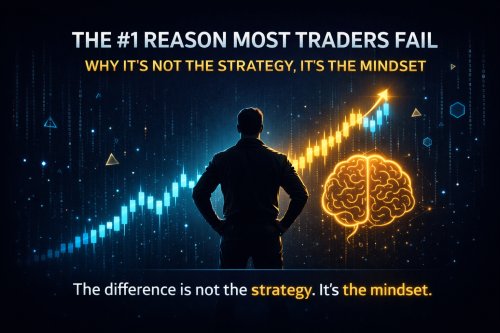
The difference is not the strategy. It's the mindset.
Quick Summary
| Section | What You Will Learn |
|---|---|
| The Hard Truth | Why strategy is only 20% of trading success |
| 5 Psychological Mistakes | Revenge trading, moving stops, over-trading, FOMO, winners to losers |
| How to Fix Each Mistake | Actionable solutions for every psychological trap |
| Trader's Action Step | Your daily practice to build discipline |
Target Keywords: trading psychology, why traders fail, discipline in forex, common trading mistakes
The Hard Truth: Strategy is Only 20% of the Equation
Most beginners spend months searching for the "holy grail" indicator or the perfect entry signal. They jump from system to system, convinced that the next one will be the answer.
But professional traders know something else:
A simple strategy followed with discipline will always outperform a complex strategy followed with emotion.
| Component | % of Success |
|---|---|
| Strategy (entries/exits) | 20% |
| Risk Management | 30% |
| Psychology & Discipline | 50% |
Your mindset determines:
-
Whether you follow your stop loss or "hope" the trade turns around
-
Whether you take a trade because it fits your plan, or because you are bored
-
Whether you can take a loss without revenge trading
-
Whether you can sit on your hands and wait for the right setup
Let's look at the five most common psychological traps.
5 Psychological Mistakes That Destroy Traders
Mistake #1: Revenge Trading
What it looks like:
You take a loss. It stings. Instead of walking away, you immediately enter another trade—often with a larger position size—to "win back" what you just lost. You are no longer trading your plan; you are trading your ego.
Why it's dangerous:
Revenge trading turns a small, manageable loss into a blown account. When you trade from anger or frustration, you throw risk management out the window.
Real example: Trader loses $100. Doubles position size to win it back. Loses $250. Doubles again. Within hours, a $100 loss becomes $1000.
How to fix it:
| Fix | Action Step |
|---|---|
| Daily loss limit | "If I lose 2% of my account in one day, I shut down completely" |
| Physical break | After a loss, stand up, walk around for 10 minutes |
| Rage log | Write down what you feel before entering another trade |
Mistake #2: Moving Stop Losses (Hope Trading)
What it looks like:
You place a stop loss at 20 pips. Price comes within 5 pips of your stop, so you move it back to 35 pips. Price gets closer again, so you move it again to 50 pips. You are no longer managing risk; you are hoping.
Why it's dangerous:
A stop loss is not a suggestion. It is your exit plan. Moving your stop turns a planned, small loss into an unpredictable, often much larger loss.
The math: A 20-pip loss is acceptable. A 50-pip loss hurts. A 100-pip loss can be catastrophic.
How to fix it:
| Fix | Action Step |
|---|---|
| Set stop before entry | Write it down before entering the trade |
| No-move rule | Never move stop loss further away (only closer to lock profit) |
| Position size check | If you cannot trust your stop, your size is too big |
Mistake #3: Over-trading (The Boredom Trade)
What it looks like:
The market is quiet. There are no clear setups. But you have been staring at the screen for an hour, so you take a "maybe" trade just to feel involved.
Why it's dangerous:
Over-trading forces you into low-probability setups. It fills your journal with random trades that have no edge, slowly bleeding your account one small loss at a time.
Signs of over-trading:
-
Trading during news events you do not understand
-
Entering trades without clear confirmation
-
Taking trades outside your regular session
-
Adding positions to "average down"
How to fix it:
| Fix | Action Step |
|---|---|
| Define setups in advance | Write down exact conditions required for entry |
| Schedule screen time | Only trade during specific hours (e.g., London open) |
| Secondary activity | Read a trading book or exercise while waiting |
Mistake #4: FOMO (Fear Of Missing Out)
What it looks like:
You see a pair moving strongly without you. You panic and enter late, often right before a reversal. You chase the move instead of waiting for a pullback.
Why it's dangerous:
FOMO causes you to buy tops and sell bottoms. You enter with poor risk-reward ratios (often risking 50 pips to make 20) and typically get stopped out immediately.
The reality: Most of the move is already gone by the time FOMO hits.
How to fix it:
| Fix | Action Step |
|---|---|
| Accept missed moves | No trader catches every move. Market will be open tomorrow. |
| Missed move rule | Wait for pullback to 50% or 61.8% retracement |
| Zoom out | Look at daily chart. One candle rarely matters. |
Mistake #5: Letting a Winner Turn into a Loser
What it looks like:
You are up 50 pips. It is a good trade. But instead of taking profits or moving your stop to break-even, you watch as price reverses and stops you out for a loss.
Why it's dangerous:
This habit trains your brain to associate winning with eventual pain. Over time, you will subconsciously sabotage winning trades.
The result: You develop a fear of being in profit, leading to premature exits or never taking the trade at all.
How to fix it:
| Fix | Action Step |
|---|---|
| Move stop to break-even | Once price moves 1R (your initial risk) in your favor |
| Partial profits | Close 50% of position at logical target, let rest run |
| Gratitude practice | A taken profit is never "small." Be grateful for it. |
Share
What's Your Reaction?
 Like
2
Like
2
 Dislike
0
Dislike
0
 Love
2
Love
2
 Funny
0
Funny
0
 Angry
0
Angry
0
 Sad
0
Sad
0
 Wow
1
Wow
1







👍 nice
Finally someone said it. I wasted 2 years chasing strategies when my brain was the problem. 😩😩😩😩
😊😊🫡🫡🫡 now i believe you will get better this time 🚀
I feel personally attacked by the 'moving stop losses' section. My stop loss has seen more movement than my legs in 2025. 😂 Great post bro.
😂thanks bro
Great work Alpha, am a big fan always following your content on instagram
🙏🏽🫡🫡🫡