
Forex 101: How to Read a Currency Pair Quote (Base/Quote)
New to Forex? Learn how to read currency pairs like EUR/USD, understand base vs quote currency, and interpret price movements in minutes.

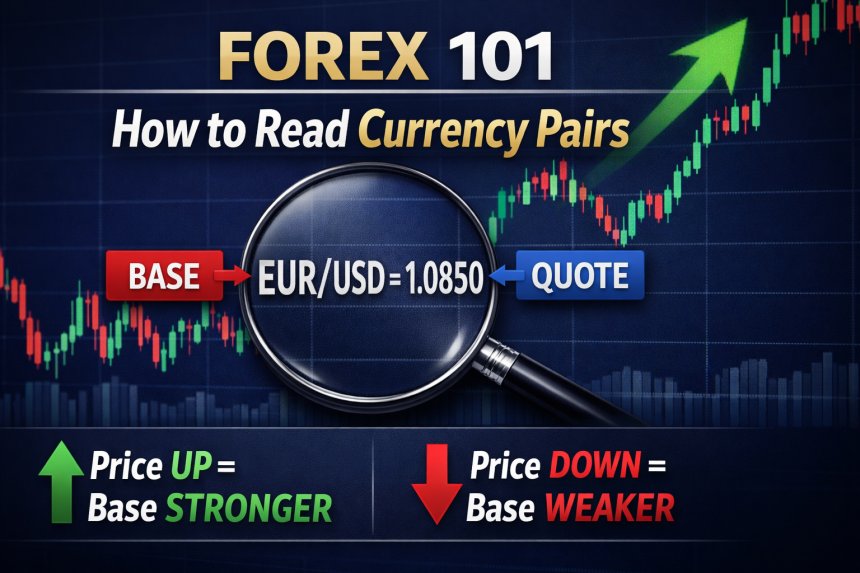
If you have ever looked at a trading platform and felt confused by symbols like EUR/USD = 1.0850, you are not alone.
For beginners, Forex quotes can look like a foreign language. But once you understand two simple words — base and quote — the entire Forex market makes sense.
In this guide, you will learn exactly how to read any currency pair, what the numbers mean, and how to tell whether a currency is getting stronger or weaker — all in plain English.
What Is a Currency Pair?
Unlike buying stocks, where you buy one thing at a time, Forex trading always involves two currencies simultaneously. When you trade Forex, you are buying one currency and selling another at the exact same moment.
That is why currencies are always shown as a pair:
EUR/USD
GBP/JPY
USD/CAD
Every currency pair has two parts:
| Position | Name | Role |
|---|---|---|
| First currency | Base Currency | The currency you are buying or selling |
| Second currency | Quote Currency | The currency you are using to pay |
Simple rule: The base currency is always 1 unit. The quote currency tells you how much it costs.
Base Currency Explained (The Easy Way)
The base currency is the first currency shown in the pair. It represents one single unit of that currency.
Let us take the most traded pair in the world: EUR/USD
| Component | Currency | Role |
|---|---|---|
| Base | EUR (Euro) | 1 Euro |
| Quote | USD (US Dollar) | How many dollars 1 Euro costs |
So when you see:
EUR/USD = 1.0850
The translation is simple:
1 Euro = 1.0850 US Dollars
That is it. No hidden complexity.
How to Read Any Forex Quote
Here are four common currency pairs broken down so you can see the pattern:
| Currency Pair | Quote | What It Means |
|---|---|---|
| EUR/USD | 1.0850 | 1 Euro = 1.0850 US Dollars |
| GBP/USD | 1.2850 | 1 British Pound = 1.2850 US Dollars |
| USD/JPY | 147.50 | 1 US Dollar = 147.50 Japanese Yen |
| USD/CAD | 1.3700 | 1 US Dollar = 1.3700 Canadian Dollars |
| AUD/USD | 0.6650 | 1 Australian Dollar = 0.6650 US Dollars |
| USD/CHF | 0.8950 | 1 US Dollar = 0.8950 Swiss Francs |
Notice the pattern:
-
When USD is the quote currency (EUR/USD, GBP/USD, AUD/USD), the number tells you how many US Dollars you need to buy 1 unit of the base.
-
When USD is the base currency (USD/JPY, USD/CAD, USD/CHF), the number tells you how many units of the quote currency you get for 1 US Dollar.
How to Read Price Movements (Up vs Down)
This is where most beginners get confused. But the rule is actually very simple:
If the pair goes UP → The BASE currency is getting STRONGER
If the pair goes DOWN → The BASE currency is getting WEAKER
Example 1: EUR/USD moves from 1.0800 to 1.0900
| Before | After | Change |
|---|---|---|
| 1.0800 | 1.0900 | UP |
-
The pair went UP ✅
-
The base currency (EUR) became stronger
-
It now costs more US Dollars to buy 1 Euro
-
The Euro is appreciating
Example 2: EUR/USD moves from 1.0800 to 1.0700
| Before | After | Change |
|---|---|---|
| 1.0800 | 1.0700 | DOWN |
-
The pair went DOWN 📉
-
The base currency (EUR) became weaker
-
It now costs fewer US Dollars to buy 1 Euro
-
The Euro is depreciating
Example 3: USD/JPY moves from 147.00 to 148.00
| Before | After | Change |
|---|---|---|
| 147.00 | 148.00 | UP |
-
The pair went UP ✅
-
The base currency (USD) became stronger
-
You now get more Japanese Yen for 1 US Dollar
-
The US Dollar is appreciating against the Yen
Bid Price vs Ask Price (Why You See Two Numbers)
When you look at a live Forex quote, you will usually see two prices side by side:
| Price | Name | What It Means |
|---|---|---|
| 1.0845 | Bid Price | The price at which the market will buy the base currency FROM you |
| 1.0850 | Ask Price | The price at which the market will sell the base currency TO you |
How to use them:
| Action | Price to Use |
|---|---|
| You want to BUY (go long) | ASK price (higher number) |
| You want to SELL (go short) | BID price (lower number) |
The difference between the bid and ask price is called the spread. This is how brokers make money.
Quick Reference Table
| If You Want To | You Look At | You Click |
|---|---|---|
| Buy EUR/USD (expect Euro to rise) | ASK price (1.0850) | BUY |
| Sell EUR/USD (expect Euro to fall) | BID price (1.0845) | SELL |
| Buy USD/JPY (expect Dollar to rise) | ASK price (147.55) | BUY |
| Sell USD/JPY (expect Dollar to fall) | BID price (147.50) | SELL |
Common Beginner Questions
❓ Which currency is base in EUR/USD?
EUR (Euro) is the base currency. USD (US Dollar) is the quote currency.
❓ What happens when I buy EUR/USD?
You are buying Euros and selling US Dollars at the same time. You expect the Euro to go up against the Dollar.
❓ What happens when I sell EUR/USD?
You are selling Euros and buying US Dollars. You expect the Euro to go down against the Dollar.
❓ Why is USD sometimes the base and sometimes the quote?
It depends entirely on the pair:
-
EUR/USD → USD is the quote currency
-
USD/JPY → USD is the base currency
There is no fixed rule. You simply remember: the first currency is always the base.
❓ What does a quote of 1.0850 actually mean in dollars?
If you buy 1,000 Euros at 1.0850, you pay 1,085 US Dollars. If the price moves to 1.0900, your 1,000 Euros are now worth 1,090 US Dollars. You made 5 dollars.
Share
What's Your Reaction?
 Like
2
Like
2
 Dislike
0
Dislike
0
 Love
1
Love
1
 Funny
0
Funny
0
 Angry
0
Angry
0
 Sad
0
Sad
0
 Wow
0
Wow
0













Very clear explanation this made currency pairs much easier to understand.
Thanks camp🫡🫡