
Beginner’s Guide to Forex Trading (2026 Update)
Beginner’s Guide to Forex Trading: Learn how forex works, key terms, simple strategies, and practical tips to help new traders succeed in 2026. A clear, easy-to-understand introduction for anyone starting out.


Beginner’s Guide to Forex Trading (2026 Update)
A simple, practical introduction for anyone starting their journey into the forex markets.
Forex trading can look confusing from the outside — charts everywhere, strange symbols like EUR/USD, and people shouting “buy” or “sell.” But once you understand the basics, forex becomes one of the most straightforward financial markets to learn.
This guide breaks everything down in a simple, beginner-friendly way.
What Is Forex Trading?
Forex (foreign exchange) trading is the buying and selling of currencies.
You are basically trading one currency for another based on which one you believe will increase in value.
Example:
If you think the Euro will rise against the US Dollar, you buy EUR/USD.
If you think it will fall, you sell it.
That’s it — simple.
Why Forex Is Popular for Beginners
Forex is the largest financial market in the world, and beginners love it because:
-
✔ Low starting capital — you can begin with as little as $10–$100
-
✔ Open 24 hours (Monday–Friday)
-
✔ You can profit in both rising and falling markets
-
✔ High liquidity — your trades open and close instantly
-
✔ Lots of free tools & education online
Common Forex Terms You Should Know
Before trading, learn these key words:
1. Currency Pair
Example: GBP/USD
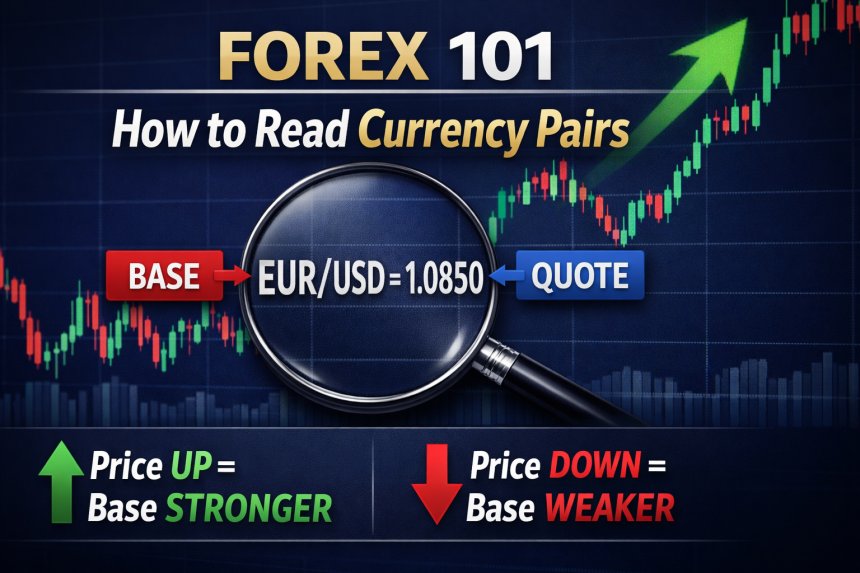
The first currency is the base, the second is the quote.
2. Lot Size
How big your trade is (0.01 = micro lot).
Beginners usually start with small lots to reduce risk.
3. Pips
Smallest movement in currency price.
Example:
If EUR/USD moves from 1.1000 → 1.1010, that’s 10 pips.
4. Leverage
Borrowed funds that make your position bigger.
Example: 1:100 leverage means $100 can control $10,000.
Be careful: leverage increases both profit AND risk.
5. Spread
Difference between buying and selling price.
Low spread = better.
How Forex Trading Works
Here’s the simple process:
-
You deposit money into a trading account.
-
You choose a currency pair (e.g., EUR/USD).
-
You buy or sell based on your analysis.
-
If you’re right, you profit.
If you’re wrong, you lose.
To trade correctly, you usually rely on two things:
✔ Technical Analysis
Using charts, indicators, patterns, and price action.
✔ Fundamental Analysis
Using economic news, interest rates, inflation, and events.
Best Forex Strategies for Beginners
Here are 3 beginner-friendly strategies that actually work:
1. Support and Resistance Trading
Look for key price levels where the market:
-
bounces up (support)
-
rejects down (resistance)
Buy at support → Sell at resistance.
Simple and effective.
2. Breakout Strategy
When price breaks above a major level, momentum usually continues.
Example:
If EUR/USD breaks a key resistance, many traders buy, pushing price higher.
This is great for trending markets.
3. Moving Average Strategy
Use the 50 EMA + 200 EMA:
-
Buy when the 50 EMA crosses above the 200
-
Sell when it crosses below
This helps beginners avoid trading against the trend.
How Much Money Do You Need to Start?
Beginners often start with:
-
$50–$200 for learning
-
$500–$1,000 for serious trading
-
Risk 1% per trade (Example: $5 risk on a $500 account)
This keeps you safe from blowing your account early.
Common Mistakes Beginners Make
Avoid these:
-
❌ Trading with emotions
-
❌ Using large lot sizes
-
❌ Overtrading
-
❌ Not using stop loss
-
❌ Chasing losses
-
❌ Trading during high-volatility news without a plan
Forex is a patience game — not a quick-rich scheme.
Tips to Succeed as a Beginner
Here are rules professionals live by:
-
✔ Trade with a plan
-
✔ Use stop loss always
-
✔ Keep risk per trade low
-
✔ Focus on 1–2 pairs (EUR/USD, XAU/USD, GBP/USD)
-
✔ Backtest your strategy
-
✔ Keep a trading journal (very important!)
Final Thoughts
Forex trading is exciting and full of opportunities, but only if you approach it with discipline and the right mindset. As a beginner, your goal is not to make fast money — your goal is to learn correctly, manage risk, and grow step by step.
If you follow the basics in this guide, you’re already ahead of 70% of new traders.
Share
What's Your Reaction?
 Like
23
Like
23
 Dislike
0
Dislike
0
 Love
12
Love
12
 Funny
0
Funny
0
 Angry
0
Angry
0
 Sad
1
Sad
1
 Wow
10
Wow
10










Bro you have the best forex blog to be honest 📈 💯
I appreciate how you emphasized mindset and discipline at the end. Too many people think forex is quick money. This guide feels realistic and honest.
Thanks for your beautiful feedback
The 50 EMA + 200 EMA strategy explanation is simple and direct. Great starting point for someone who doesn’t want too many indicators.
Thats so true especially if you take the market as business not a gamble
Very helpful breakdown of common mistakes. I personally learned the hard way about overtrading. This guide would’ve saved me some money earlier 😅
😅😅😅😅 Sorry but the now that you have realised you are atlest some steps a head now...!
The risk management section is gold. A lot of beginners ignore the 1% rule and blow accounts fast. Good reminder that forex is a patience game.
thanks for your great feedback
I like how you explained support and resistance in a simple way. Most articles overcomplicate things. This feels beginner-friendly and practical.
Exactly @Sofia i hope you implement into your trades too